How to Reduce Your Motor Noise by Optimizing Magnet Tolerance
Strategies for Global Sourcing Managers and Product Engineers to achieve quieter, more stable motor performance.
If you are a product engineer or sourcing manager dealing with permanent magnet electric motors, you know that motor noise and vibration are some of the most frustrating challenges to troubleshoot. While it’s easy to blame the bearings, the casing, or the drive algorithm, the real culprit is often hidden in plain sight: the dimensional tolerance of your NdFeB magnets.
At Skyup Magnetics, with over 15 years of OEM expertise, we’ve seen how a fraction of a millimeter can make or break a motor’s performance. Here is a practical look at how optimizing magnet tolerance can directly reduce motor noise, improve stability, and save you from assembly headaches.

1. The Baseline: Standard Shapes and Tolerances
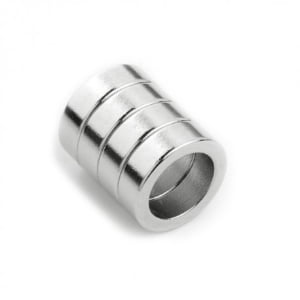
Sintered Neodymium-Iron-Boron (NdFeB) magnets come in various shapes depending on the motor design—most commonly blocks, discs, rings, arcs (segments), and custom profiles.
- Standard Tolerance: Generally ±0.1mm for industrial applications.
- High Precision: For smaller or high-performance components, we tighten this to ±0.05mm.
While these numbers seem microscopic, in the world of high-speed rotation, they represent a massive variable in performance consistency.
2. The Ripple Effect: How Tolerance Impacts Motor Stability
Why does a ±0.1mm difference cause motor noise? It all comes down to magnetic flux consistency.
The Core Logic: The tighter the dimensional tolerance, the more consistent the magnetic material volume, leading to a more uniform magnetic field.
- Uniform Rotation: When magnet dimensions are strictly controlled, the magnetic flux remains highly uniform across all poles. This reduces cogging torque and vibration, resulting in a quieter motor.
- The Danger of Fluctuation: If tolerances are too broad, the magnetic flux fluctuates from piece to piece. This creates irregular magnetic pull against the stator, leading to a “bumpy” rotation and increased acoustic noise.
3. The Assembly Nightmare: The “Last Magnet” Problem
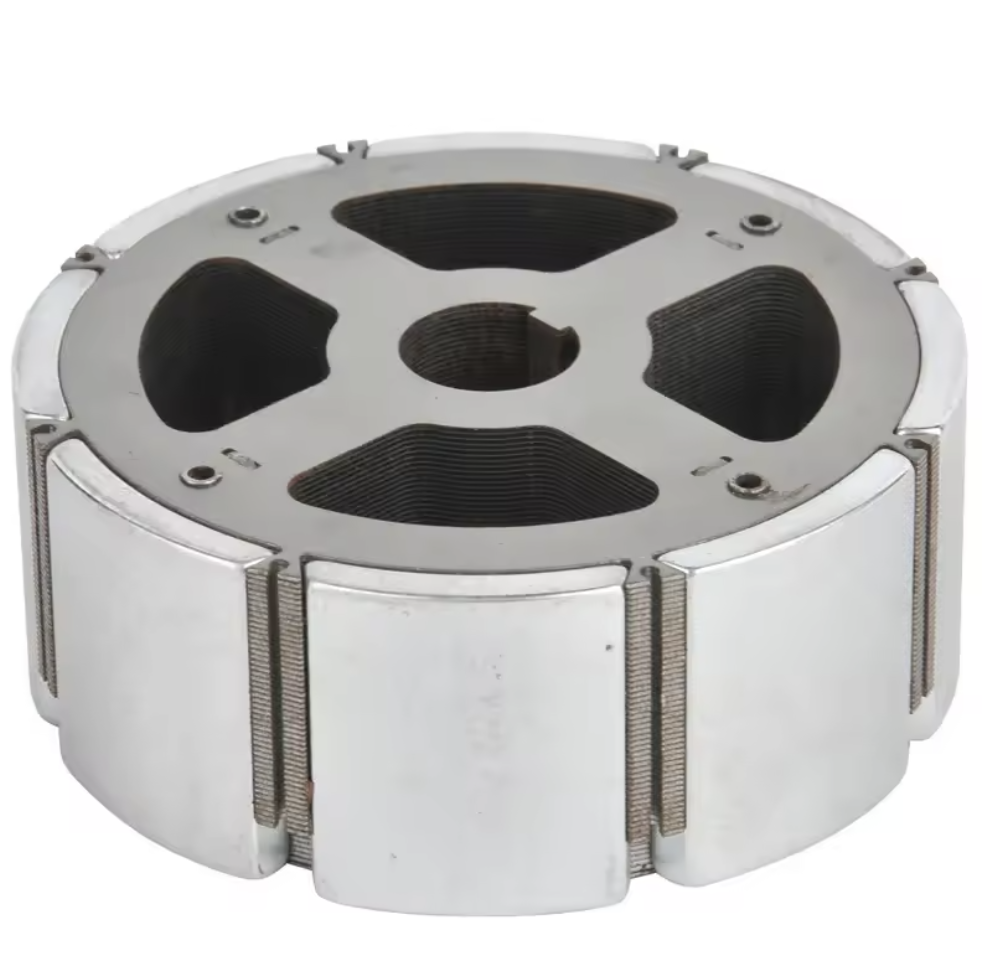
Beyond electromagnetic performance, loose tolerances can derail your production line. Consider the common process of assembling arc magnets into a rotor:
If the tolerance is slightly oversized (e.g., at the +0.1mm limit), that error accumulates as you place magnets around the circumference. By the time you try to insert the final piece, the remaining gap is often too small. This causes:
- Difficulties in manual or automated insertion.
- Increased risk of magnet chipping or cracking.
- Higher scrap rates and production delays.
4. Finding the Engineering Sweet Spot
Designing the perfect magnet specification requires balancing several critical factors:
| Factor | Impact |
|---|---|
| Assembly Gap | Ensures the “last piece” fits perfectly in the rotor. |
| Machining Precision | Determines the cost-to-performance ratio. |
| Flux Consistency | Directly correlates to motor stability and low noise. |
Why Choose Skyup Magnetics for Your Motor Projects?
Finding this balance is where a reliable, “frictionless” partner makes the difference. At Skyup Magnetics, we focus on the “workhorse” N, M, H, and SH series grades to provide a stable supply chain.
- Massive Tooling Library: Access to thousands of existing molds to eliminate “open-mold” expenses.
- Free Samples: We provide free samples for new projects to allow for dimensional verification and acoustic testing.
- Rapid Validation: Our efficient workflows ensure your speed-to-market is never compromised.
Contact Us for a Precision Quote
Ready to reduce your motor noise and optimize your assembly process? Contact our engineering team today.
Email: Marketing@cnmagnets.com
Tel/WhatsApp: 0086-15757403848
Website: www.cnmagnets.com