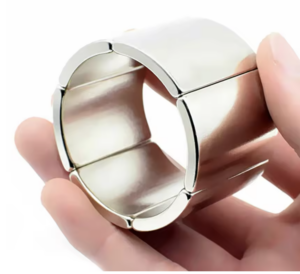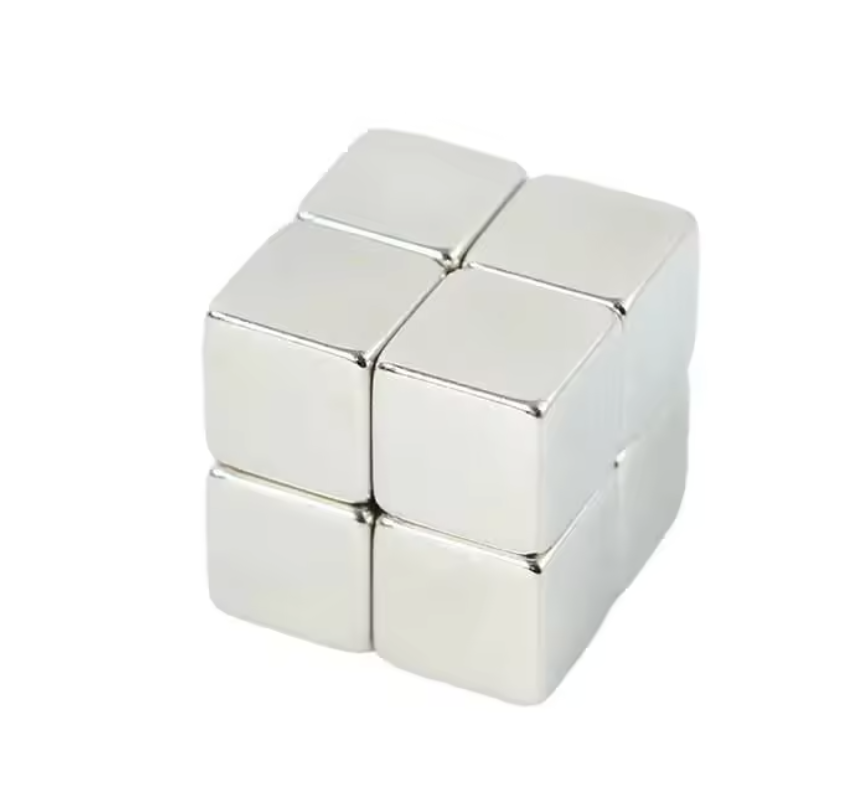
Choosing the wrong magnetic material for your next product launch leads to premature demagnetization or completely blown production budgets. Too often, I see engineers simply request the "strongest" material, only to discover it fails under heat or is unnecessarily expensive for their design. Understanding the different grades of neodymium magnets ensures you balance magnetic output, thermal stability, and cost-effectiveness for your specific OEM application.
The different grades of neodymium magnets are classifications based on their maximum energy product and intrinsic coercivity. The naming system starts with an "N" followed by a number representing magnetic strength (like 35 to 54). A letter suffix, such as M, H, or SH, indicates the material's coercivity and its ability to resist demagnetization at higher operating temperatures.
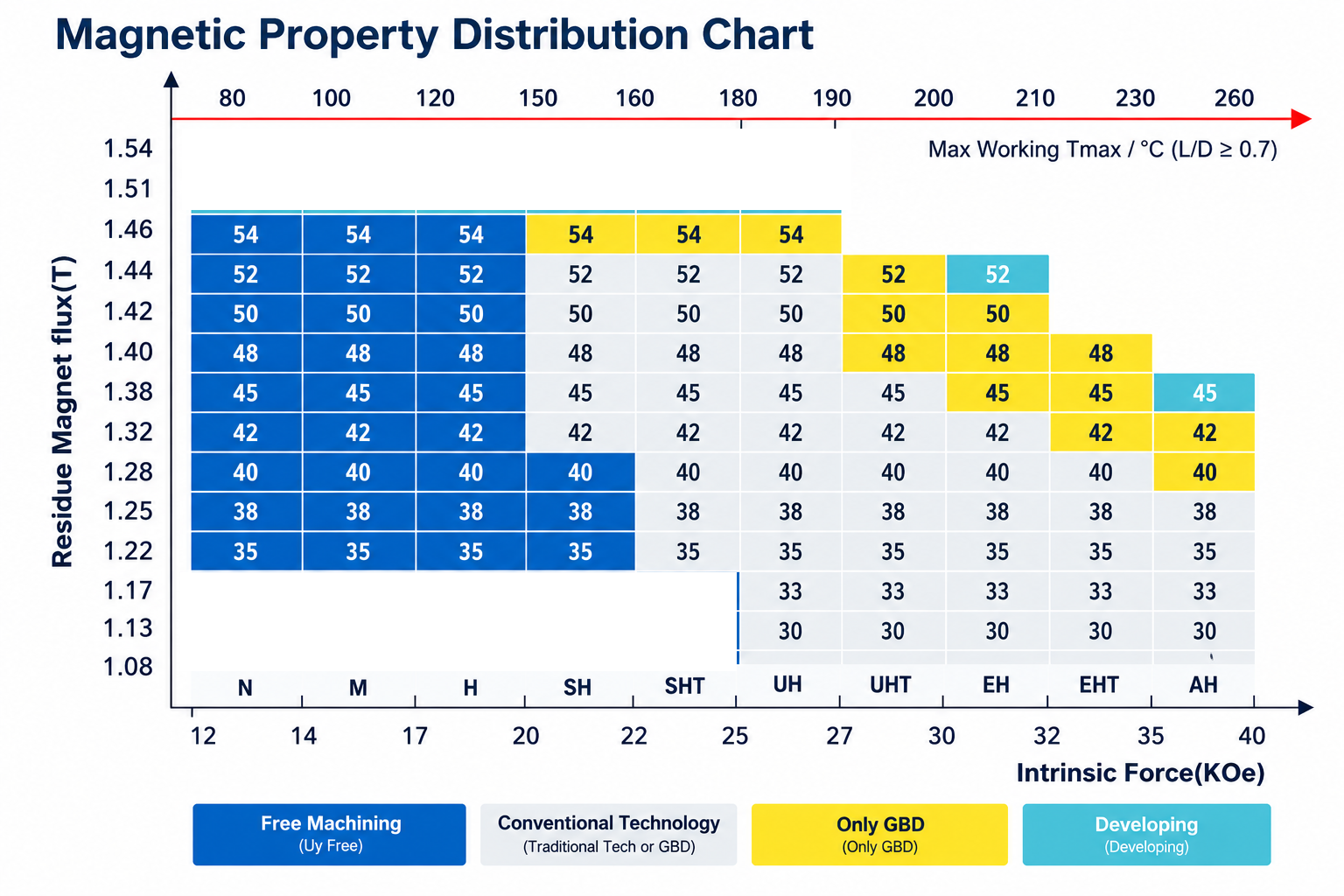
Let’s break down exactly what these numbers and letters mean, how they impact your magnetic circuit, and why selecting the right sintered NdFeB material requires looking far beyond just raw maximum strength.
How Do You Read the Grades of Neodymium Magnets?
Magnet specification sheets often look like confusing alphabet soup to those outside the industry. Misinterpreting a grade like N42SH versus a standard N42 can lead to ordering mass-production parts that permanently lose their strength in the field. Learning the basic naming convention clarifies exactly what performance level you are evaluating.
You read the grades of neodymium magnets by looking at two distinct parts. The number (e.g., 45, 52) indicates the maximum energy product (BHmax) in Mega-Gauss Oersteds (MGOe)1. The letter suffix (e.g., M, H, SH) represents the intrinsic coercivity category, which dictates the magnet's resistance to thermal demagnetization.
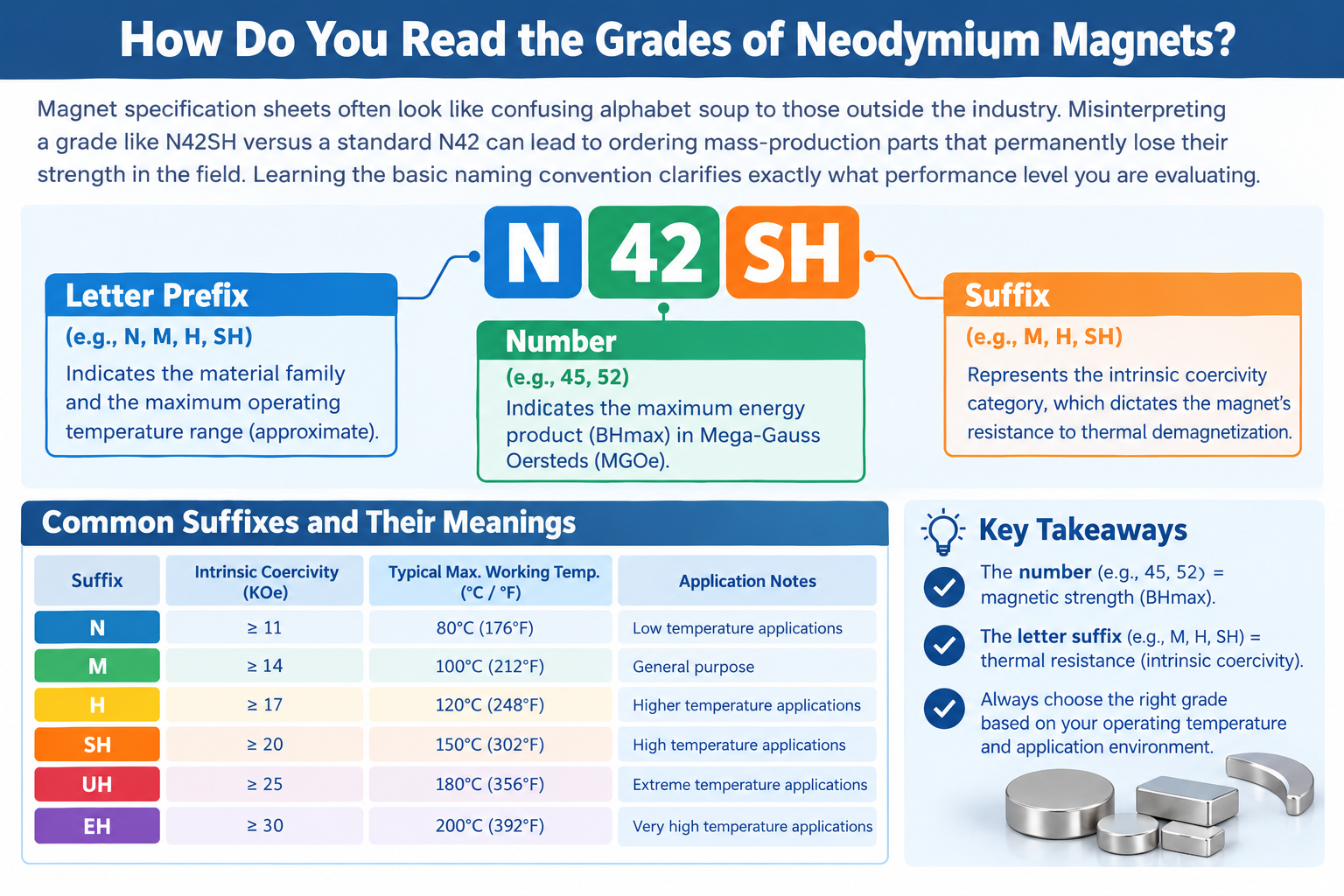
When discussing new OEM projects, I often see procurement managers assume a higher number is universally better. In reality, grades are not a simple strength ranking. A grade is a specific combination of properties designed to meet different operational constraints. The number tells you the theoretical maximum energy the magnet can store. For instance, an N52 has a higher energy density than an N35, allowing you to achieve the same magnetic field with a physically smaller magnet.
However, the letters at the end are just as critical, if not more so, for industrial applications. These suffixes classify the material's temperature and coercivity performance based on standards like GB/T 13560 or IEC 60404-8-12.
Here is a general breakdown of the common suffixes:
| Suffix | Meaning | Typical Max Operating Temp |
|---|---|---|
| (None) | Standard (N series) | ≤ 80°C |
| M | Medium Coercivity | ≤ 100°C |
| H | High Coercivity | ≤ 120°C |
| SH | Super High Coercivity | ≤ 150°C |
| UH | Ultra High Coercivity | ≤ 180°C |
| AH | Advanced High Coercivity | ≤ 220°C |
Note: These temperature ratings are general guidelines. Actual performance depends heavily on the magnet's working point and geometry.
When you evaluate a supplier, you should always verify these numerical ranges against the applicable standard or the supplier’s specific datasheet. Neodymium grades are about finding the precise intersection of energy output and environmental resilience required by your specific magnetic circuit.
Which Grades of Neodymium Magnets Are Best for High Temperatures?
High operating temperatures are the ultimate enemy of permanent magnets. If an application overheats, standard magnets suffer irreversible flux loss, causing industrial motors to stall or precision sensors to fail. Specifying high-coercivity grades protects your product from rapid thermal degradation and expensive field failures.
The best grades of neodymium magnets for high temperatures feature suffixes like H, SH, UH, EH, or AH. While standard N-series magnets typically operate safely up to 80°C, these high-coercivity alternatives maintain magnetic stability in demanding environments where peak temperatures exceed 100°C to 200°C.

The N series—those without a letter suffix—are ideal for applications operating at room temperature or strictly below 80°C. They are cost-effective and offer excellent energy density for consumer electronics, standard magnetic separators, and household door catches. However, industrial environments often push boundaries.
For example, I once worked with a client developing a high-performance linear motor. Their initial design calculations assumed an operating temperature of 70°C, which would theoretically allow a standard N-series material. However, we discovered that during overload conditions, the actual operating temperature occasionally spiked past 80°C. If they had proceeded with the standard N-grade, the magnets would have suffered irreversible demagnetization during those peak loads. We recommended switching to an M or H grade to provide a necessary thermal safety buffer without drastically increasing the cost.
It is crucial to understand that demagnetization risk is not determined by temperature alone. A higher-numbered grade can still be unsuitable for a demanding operating condition. The magnet's geometry (its permeance coefficient) and the presence of reverse magnetic fields matter just as much as a standalone temperature rating. A thin, flat magnet will demagnetize at a much lower temperature than a thick, tall magnet3 of the exact same grade. Therefore, I never recommend a final grade without calling for application-specific validation and rigorous sample testing in the actual assembly.
How Do Br and Hcj Impact Different Grades of Neodymium Magnets?
Buyers often focus solely on the "pull force" they want their product to achieve. Unfortunately, pull force alone doesn't tell you if the magnet will survive opposing magnetic fields in a motor or survive extreme environmental conditions. Understanding Remanence (Br)4 and Intrinsic Coercivity (Hcj)5 helps you select a material that actually survives your specific application over the long term.
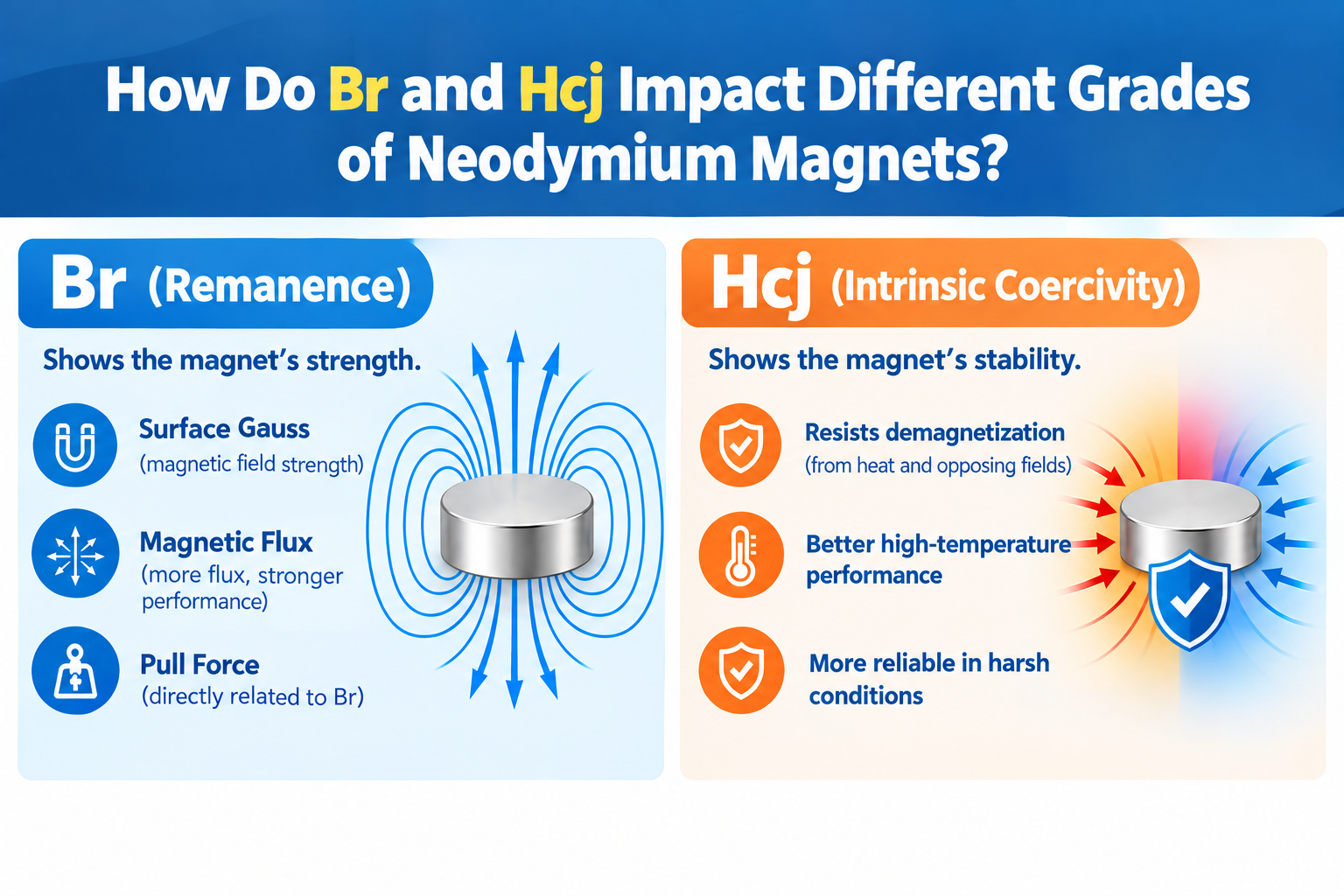
Br and Hcj dictate the grades of neodymium magnets by defining both strength and stability. Br (Remanence) correlates directly to the magnet's central surface gauss, magnetic flux, and physical pull force. Hcj (Intrinsic Coercivity) measures the magnet's ability to resist demagnetization from heat and opposing magnetic fields.
When I review a new inquiry with procurement managers and product engineers, I try to reframe the question "Which grade is strongest?" to "What must the magnet do?" The answer lies in the balance between Br and Hcj.
- Remanence (Br): This value indicates how much magnetic flux remains in the material after it is fully magnetized. If your primary goal is maximizing holding force or creating a very strong surface field (surface gauss), you need a material with a high Br.
- Intrinsic Coercivity (Hcj): This value is your safety net. The higher the Hcj, the better the product’s high-temperature anti-attenuation performance. If your application involves high heat or strong opposing magnetic fields (like in a rotor), Hcj is your most critical metric.
In materials science, there is almost always a trade-off. It is physically difficult to achieve maximum Br and maximum Hcj simultaneously6. For instance, an N54 grade will have a massive Br value, providing incredible holding force at room temperature, but its Hcj is relatively low. Conversely, an N35AH has a very high Hcj, allowing it to survive extreme heat, but its Br is much lower.
Therefore, selecting the right grade requires a holistic view. We start with continuous and peak temperatures, target force or flux, magnetic-circuit design, magnet dimensions, shape, and magnetization direction. By analyzing these factors together, we can pinpoint the precise grade that delivers reliable performance without over-engineering the component.
Are Grades of Neodymium Magnets the Only Specification That Matters?
Selecting the perfect grade on paper does not guarantee a successful final product. If you ignore manufacturing constraints and supply chain variables, you might specify a material that is impossible to machine, rusts quickly in the field, or varies wildly from batch to batch. Treat the grade as just one part of a comprehensive component specification.
No, the grades of neodymium magnets are only a starting point. To ensure reliable performance, buyers must also specify precise dimensional tolerances, protective coatings for corrosion resistance, machining feasibility, and the supplier’s batch-to-batch consistency under actual mass production conditions.
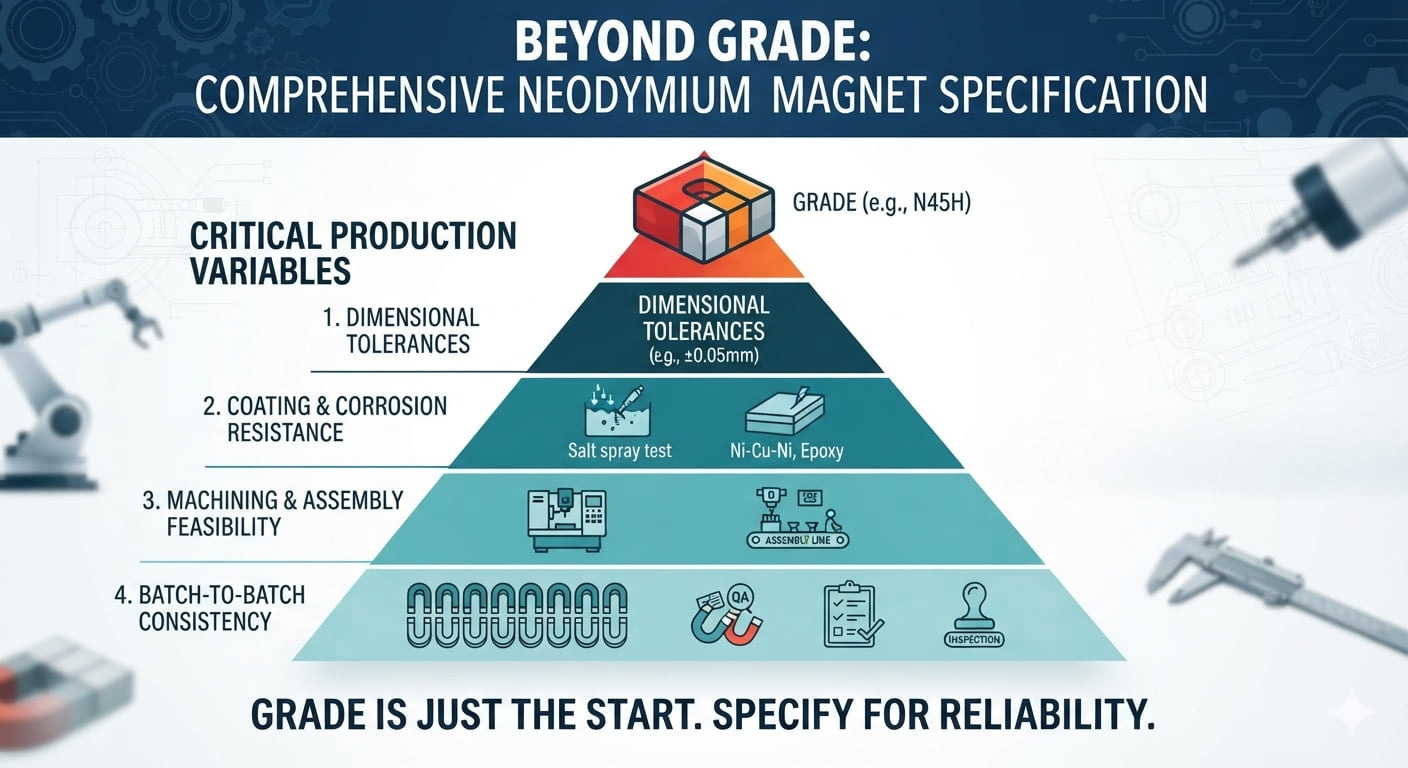
A grade defines the raw material's potential, but transforming that material into a reliable OEM part requires extensive manufacturing expertise. Sintered NdFeB is notoriously hard and brittle. Can your required geometry actually be pressed and machined efficiently? This is where tooling capabilities come into play. A mature supplier will have thousands of pressing molds for cylinders, blocks, arcs, and custom shapes, which drastically shortens development time and ensures geometric consistency.
Furthermore, neodymium magnets are highly susceptible to corrosion7. The operating environment dictates the necessary surface treatment. Whether it is a standard NiCuNi (Nickel-Copper-Nickel) plating, Zinc, or an Epoxy coating for harsher environments, the coating is just as critical as the internal magnetic grade.
Finally, batch consistency separates standard suppliers from reliable OEM partners. A golden sample is easy to produce, but maintaining ±0.05mm dimensional tolerances and stable magnetic flux across thousands of parts requires stringent Statistical Process Control (SPC). At Skyup Magnetics, we manage the entire end-to-end process—from raw material traceability to 100% outgoing cosmetic and magnetic inspections. Notably, our core N/M/H/SH series magnets require no dual-use export control certificates, eliminating frustrating customs delays and compliance risks for our international buyers.
Frequently Asked Questions
What is the strongest grade of neodymium magnet available?
Currently, N52 to N55 are considered the strongest grades in terms of Maximum Energy Product (BHmax)8. However, they have relatively low intrinsic coercivity and are generally restricted to room-temperature applications without strong opposing magnetic fields.
What is the difference between an N42 and an N42SH?
Both grades have the same maximum energy product (BHmax) and will provide similar magnetic strength at room temperature. The key difference is the "SH" suffix, meaning the N42SH has much higher intrinsic coercivity (Hcj) and can withstand significantly higher operating temperatures before demagnetizing.
Can I use standard N-series magnets in industrial electric motors?
It depends entirely on the motor's operating and peak temperatures. Standard N-series magnets are limited to around 80°C. Because industrial and linear motors often exceed this under load, engineers typically select M, H, or SH grades to prevent irreversible flux loss.
How do I verify that I received the correct grade from my supplier?
The most accurate way is requesting testing via a Hysteresisgraph to generate a demagnetization curve9. For incoming QC, buyers usually verify the grade by comparing the part's measured surface gauss or magnetic flux against the agreed-upon engineering drawings and standard grade specifications.
Conclusion
Understanding the different grades of neodymium magnets is essential for designing reliable, cost-effective industrial products. By recognizing that the number represents energy product while the letter suffix dictates thermal and coercivity limits, you can avoid the costly mistake of over-specifying or under-protecting your components. Always remember that the grade is just the foundation—machining, coating, and batch consistency are what turn a good material into a great OEM part.
If you are navigating material selection for a new project or facing supply chain inconsistencies, contact Skyup Magnetics. With over 15 years of OEM manufacturing experience, thousands of custom molds, and core products that require no dual-use export certificates, we provide stable, high-quality sintered NdFeB solutions. Reach out to our technical team today—we offer free sample production for new projects to validate your design.
"Maximum energy product", https://en.wikipedia.org/wiki/Maximum_energy_product. Technical references on permanent magnets confirm that the numerical component of NdFeB grade identifiers historically reflects the nominal maximum energy product ((BH)max) in units of Mega-Gauss Oersted (MGOe). Evidence role: definition; source type: encyclopedia. Supports: The conventional nomenclature of NdFeB magnets, where the numeric index denotes the nominal maximum energy product in MGOe.. ↩
"IEC 60404-8-1:2015", https://webstore.iec.ch/en/publication/22009. Standards such as IEC 60404-8-1 and GB/T 13560 define the standardized classification, minimum magnetic property thresholds, and designation rules for commercially produced sintered permanent magnets. Evidence role: definition; source type: institution. Supports: International and national specifications defining classification schemes, magnetic properties, and grade designations for sintered NdFeB materials.. Scope note: Specific grade designations and testing tolerances can vary slightly between international IEC standards and national Chinese GB standards. ↩
"Effects of Length-to-Width Ratio on Magnetic and ... - PMC", https://pmc.ncbi.nlm.nih.gov/articles/PMC11547359/. Experimental investigations indicate that low-permeance geometries (thin or flat profiles) experience higher internal demagnetizing fields, causing the knee of the B-H curve to intersect the operating line at substantially lower temperatures. Evidence role: mechanism; source type: paper. Supports: The geometric dependence of the self-demagnetizing field and its impact on the critical demagnetization temperature.. Scope note: Calculations assume open-circuit conditions; closed magnetic circuits with low air gaps attenuate this effect. ↩
"Remanence", https://en.wikipedia.org/wiki/Remanence. Textbooks on ferromagnetic materials define remanence (Br) as the residual magnetic induction present in a saturated ferromagnetic or ferrimagnetic material after the applied magnetizing force is reduced to zero. Evidence role: definition; source type: education. Supports: The physical definition of remanence (Br) as the residual induction in a closed magnetic circuit following complete saturation.. ↩
"Coercivity", https://en.wikipedia.org/wiki/Coercivity. Magnetic materials literature identifies intrinsic coercivity (Hcj or Hci) as the demagnetizing field required to reduce the internal magnetic polarization (J or M) to zero, serving as the definitive measure of stability against thermal and external field demagnetization. Evidence role: definition; source type: research. Supports: The role of intrinsic coercivity (Hcj) in measuring polarization stability against thermal excitation and opposing fields.. ↩
"Microscopic origin of coercivity enhancement by dysprosium ...", https://link.aps.org/doi/10.1103/PhysRevB.106.054422. Materials science research demonstrates that substituting dysprosium (Dy) or terbium (Tb) for neodymium enhances magnetocrystalline anisotropy and coercivity (Hcj), but antiferromagnetic coupling with iron concomitantly reduces saturation magnetization and remanence (Br). Evidence role: mechanism; source type: paper. Supports: The metallurgical trade-off between remanence and coercivity caused by heavy rare-earth element doping in Nd-Fe-B alloys.. Scope note: Recent grain boundary diffusion (GBDP) techniques mitigate this trade-off, though they do not fully eliminate it in high-performance grades. ↩
"Magnetic Properties and Corrosion Resistance of Sintered Nd ...", https://pmc.ncbi.nlm.nih.gov/articles/PMC12194711/. Corrosion studies demonstrate that the intergranular Nd-rich phase in sintered NdFeB possesses a significantly more negative electrochemical potential than the matrix Nd2Fe14B phase, inducing severe galvanic corrosion and material disintegration in moist environments. Evidence role: mechanism; source type: paper. Supports: The electrochemical vulnerability of the intergranular phase in NdFeB that drives rapid galvanic corrosion in humid or saline environments.. ↩
"Maximum energy product", https://en.wikipedia.org/wiki/Maximum_energy_product. Reviews of rare-earth magnet development show that commercial sintered Nd-Fe-B magnets achieve energy products between 52 and 55 MGOe (~414–438 kJ/m³), approaching the theoretical limit of ~64 MGOe calculated for pure Nd2Fe14B. Evidence role: statistic; source type: paper. Supports: The commercial state of the art regarding maximum achievable energy products in sintered NdFeB magnets.. Scope note: N55 grades are commercially niche and generally constrained by strict temperature and operating environment limitations. ↩
"(PDF) Measurements of magnetic materials", https://www.academia.edu/56790018/Measurements_of_magnetic_materials. Standard measurement protocols such as IEC 60404-5 prescribe the use of closed magnetic circuit permeameters (hysteresisgraphs) to determine the full B-H and J-H demagnetization characteristics of magnetically hard materials. Evidence role: general_support; source type: institution. Supports: Standardized metrological procedures for measuring demagnetization curves of permanent magnetic materials using closed-circuit permeameters.. ↩